Concrete parking lot building in Santa Barbara CA - a lot that drains and holds up
Lot cracking, sinking or holding water after rain? We build concrete lots on a packed base, thick enough for your vehicles and planned to drain.
- Fully licensed and insured.
- Free in-person estimates.
- We reply within 1 business day.
What goes into building a concrete parking lot in Santa Barbara?
Concrete parking lot building in Santa Barbara means preparing the ground the pavement sits on, then placing concrete thick enough for the vehicles that will use it, with drainage planned in from the start. Built that way, a concrete lot can give many years of service with little maintenance.
Most calls about a lot start with old paving that's cracking and holding water, or a new building that needs a place to park. The price moves with the size of the paved area, the vehicles it has to carry, what's under the old surface and how much storm water work the city asks for. The schedule turns mostly on whether your project needs city review before we can pour. The written estimate I send spells out each of those for your lot, so you can see where the money goes before you decide.
How do you know your parking lot needs to be rebuilt?
Water standing after rain
Puddles that sit in the stalls or run toward the building after a storm usually mean the surface was sloped wrong or has settled in spots. Standing water softens the ground under the paving, so the low spots tend to grow every winter.
Cracks where trucks turn
Cracks that branch out, or slabs that rock or drop near the entrance, usually mean the pavement is too thin for the traffic or the ground under it has given way. Patching buys a little time, but the broken pieces keep loosening until that section has to come out.
Old paving coming apart
Crumbling edges, potholes and loose pieces across a lot often mean it's past patching. Once the base shows through, water gets underneath and the repair grows, so it's worth pricing a rebuild before the next rainy season.
How we handle concrete parking lot building
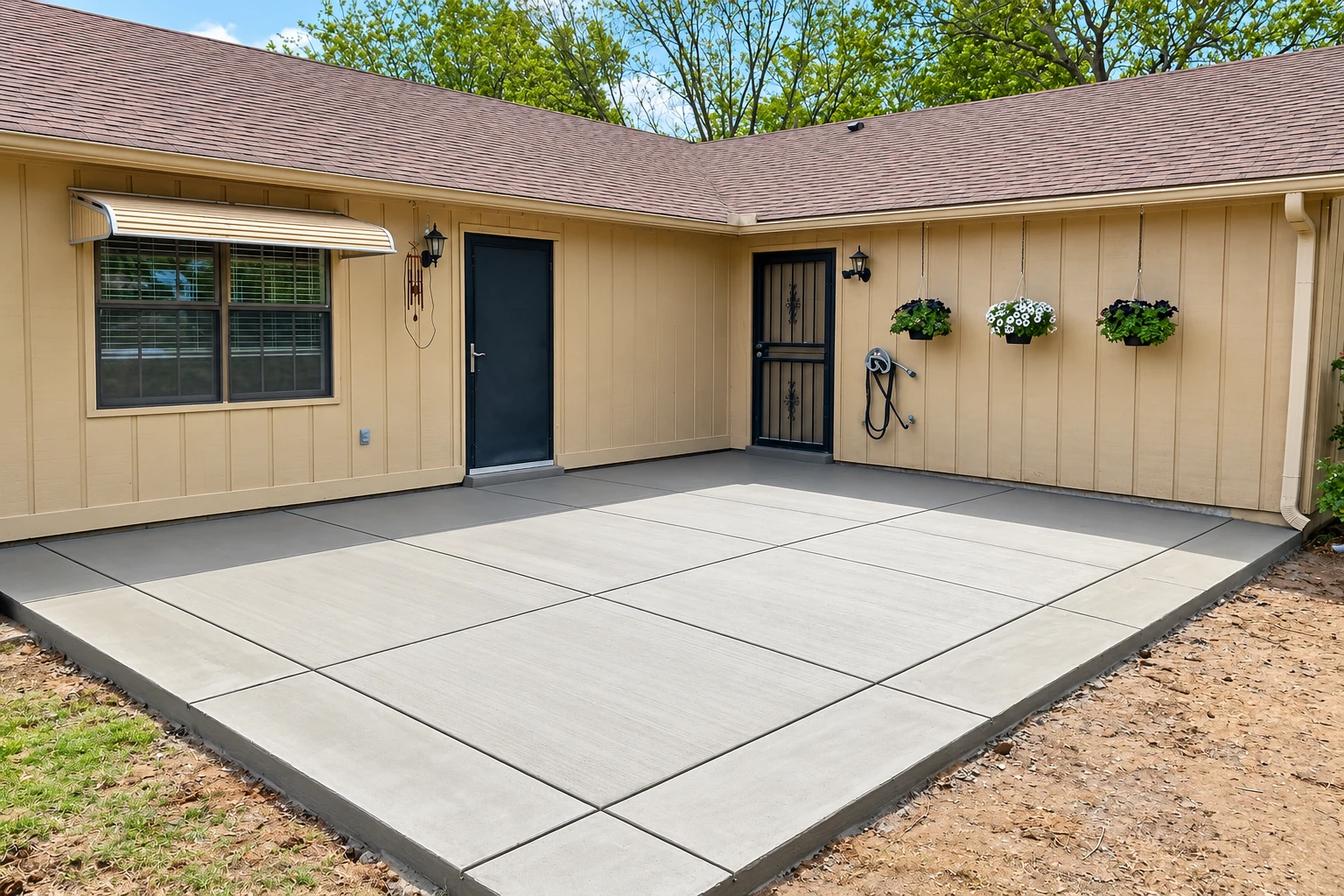
I start with the vehicles that will use the lot and the size of the paved area. Traffic sets how the pavement is built and size sets how much storm water work it needs, so drainage goes into the plan and the budget from the first visit. On the job we break out and haul off any old paving, then dig down to firm soil and grade and pack the subgrade, the ground the slab sits on, so it's even all the way across. We set forms so every part of the lot falls toward a drain or a planted area and away from the building, and we add rebar, the steel that helps hold the slab together, where the design calls for it. We pour in the cooler part of the day so the top doesn't dry out weak and dusty. Then we give it a broom finish, a light texture that keeps tires and shoes from slipping, and cut control joints, shallow grooves that give the concrete a place to crack in a straight line, while the slab is still young. Traffic stays off while it cures and gains strength. If the budget gets tight, I'll trim the finish before I trim the ground work, because a nice surface on a soft base cracks just the same, and nobody can fix the base once it's covered.
Lots often come with other concrete work. Light poles, carport posts and sign bases each need their own concrete footings, and it's easier to set them before the pavement goes down than to cut into new concrete later. If the building beside the lot has settled and you're seeing sticking doors or cracked walls, it's worth looking at foundation raising first, so we set the lot's grades against a building that's back where it belongs.
Solid pavement sized to your traffic
This is the standard lot for most owners, broom-finished and built heavier where delivery trucks or larger vehicles come through. It suits offices, shops and apartment lots where the pavement has to carry the load and send water to a drain.
Pervious concrete
Pervious concrete is very porous, so rain passes through it into the ground instead of running off the lot. It can make sense where storm water is the hard part of the job, and I'll tell you on the visit whether your site looks like a fair fit.
Get a written estimate for your parking lot
We reply within one business day to set up a visit. I come out, measure and look at how water runs across the lot, then send a free written estimate with no obligation.
(805) 869-0160- Based in
- Santa Barbara, CA 93101
- Hours
- Mon–Fri: 6 AM–10 PM, Sat–Sun: 8 AM–10 PM
What happens when you call about a parking lot in Santa Barbara?
From your first call to the final walk-through, here's who does what and what you'll have in hand before you decide.
Call or send the form
You reach us at (805) 869-0160 or through the form, and we set a time for me to come out. If you have site plans or a survey, keep them handy for the visit.
I walk the site and measure
I measure, look at the ground and how water moves across it, and ask what will park there and how often. The written estimate that follows spells out the base work, thickness, drainage and removal, so you can compare bids line by line instead of guessing what's left out.
We check permits and prep
Before we set a date we check what the job needs from the city or county and plan the schedule around any review and inspections. Then we get the site fully ready, with old paving out and the subgrade packed.
We pour and walk it together
Our crew forms, pours and finishes with me on site, and the lot stays closed to traffic while it cures. When it's done I walk the finished lot with you and go over when it's ready for cars.
Why Santa Barbara property owners call Premier Santa Barbara Concrete for parking lots
I do the estimate myself
I come out for every site visit and estimate, and I'm on site while our crew forms, pours and finishes. The person who looked at your drainage is the one checking the grades on pour day.
In business since 2017
I learned the trade on a flatwork crew in Santa Barbara, starting with forms, pours and finishing, before I started this business. That's why I check the parts you can't see later, the ground, the forms and where the water goes.
Fully licensed and insured, easy to check
We're fully licensed and insured. In California, pavement and flat concrete work fall under the concrete classification at the state licensing board, so it's worth looking up any contractor you're comparing.
If you're planning a new lot or replacing an old one, ask for an estimate and I'll start with the ground and the water.
Parking lots, drainage and permits in Santa Barbara
In Santa Barbara, any project that adds or replaces hard surface has to meet the city's storm water requirements, so tearing out an old lot counts the same as building a new one. The city sorts projects into tiers by the square feet of new or replaced surface, with new tiers starting at 500, 2,000 and 15,000 square feet. A lot of 15,000 square feet or more must also hold on site the runoff from a storm of up to 2.4 inches of rain in 24 hours. The city expects that water to soak into the ground unless contamination, high groundwater, slow-draining soil, a slope or another safety concern rules it out, and a licensed geotechnical engineer has to identify that concern in writing. If your project needs design review or development review, it starts with a planning application to the city, and the city's parking design standards apply to lot changes that need design review or a building permit, with waivers possible where they're warranted. I can't tell you which permit your lot needs until we check, so we check with the city or county office that covers your address before we set a date, and if a permit is needed we pull it or walk you through it.
On older lots around here we usually find the same few problems, paving laid over raked dirt, no plan for where the water goes, and low spots that send it toward the building. We look for all of that on the first visit, and we do the same work on jobs in Goleta and Carpinteria, where we check with that city's own office before we plan the schedule.
Questions about concrete parking lots in Santa Barbara
How much does a concrete parking lot cost in Santa Barbara?
Concrete slab and pad work without staining or stamping usually runs about $7 to $14 per square foot in Santa Barbara, and that's the area's going rate, not a quote from us. Where a lot lands depends on how thick it has to be, how much old paving comes out, the ground underneath and the storm water work. Your written estimate breaks each of those out.
How thick should a concrete parking lot be?
It should be thick enough for the heaviest vehicles that use it, the ground it sits on and the strength of the concrete, so no single number fits every lot. Trade guidance says unreinforced concrete is usually fine for cars and pickups only, and lots that see light trucks may need thicker pavement. Tell me what parks and delivers there, and I'll size it from that.
Do Santa Barbara storm water rules apply if I'm replacing an old parking lot?
Yes, replaced paving counts the same as new under the city's storm water rules. How much treatment you need depends on the lot's size, following the tiers described above. If the project goes to the Planning Commission, a storm water report and a grading and drainage plan have to be in before the application counts as complete.
Do accessibility rules apply to a private parking lot in California?
They do if the lot serves a privately owned public accommodation or commercial facility, such as a store or an office, and California's building code accessibility rules also cover government buildings and public housing. Questions about what your lot needs go to the building official who handles plan review, and we build to the approved plans.
How do I keep a new concrete parking lot from cracking?
You can't stop concrete from cracking entirely, but you can control where it cracks and keep it from breaking up. Trade guidance puts most of that on the ground underneath, which should be even in soil type, moisture and density, with odd spots dug out and replaced with similar material, and it doesn't call for an extra base layer. Beyond that, it comes down to pavement sized for the traffic.
How long does it take to build a concrete parking lot in Santa Barbara?
The work on site is usually the shorter part, and city review is often what sets the date. For projects under design review, storm water compliance has to be shown before final design approval, and for projects that only need a building permit, the permit review checks it, so we plan around whichever applies. After the pour the lot stays closed while the concrete cures, and I'll give you the timing for your lot on the estimate.
Related concrete work around a parking lot
Concrete footings
Anything standing at the edge of a lot, from light poles to carport posts, needs a solid footing below it, and it's simplest to set those before paving.
Foundation raising
When a building beside your lot has sunk and doors stick or walls crack, raising it first gives the paving a steady edge to meet.
Service areas we cover for parking lots
Premier Santa Barbara Concrete is based in Santa Barbara, California, and builds parking lots across the South Coast. The eight cities below have their own pages, including Montecito and Santa Ynez, and we work in the cities around them as well.
Santa Barbara, CA
Get your parking lot measured and priced
Call or send the form with the lot's rough size, the vehicles it serves and whether it replaces old paving, and I'll come out ready to talk thickness and drainage.